Start with a child-sized story
A picture book needs one character a child cares about, one problem and a satisfying turn at the end. That problem can be tiny by adult standards, like a lost hat or a kite stuck in a tree, as long as it feels huge to the character. Write your idea in a single sentence before you draft anything. If that sentence needs an "and also", you probably have two books.
Remember who the book is for. It will be read aloud by an adult to a child, often many times, so both of them need something to enjoy.
Know the 32-page format
Most picture books are 32 pages long. Penguin's guide for writers says story picture books usually are, and Writer's Digest notes that 24 and 40 pages also exist. Those 32 pages make 16 spreads, and once the title page, copyright page and dedication take their space, you usually have about 12 to 14 spreads for the story.
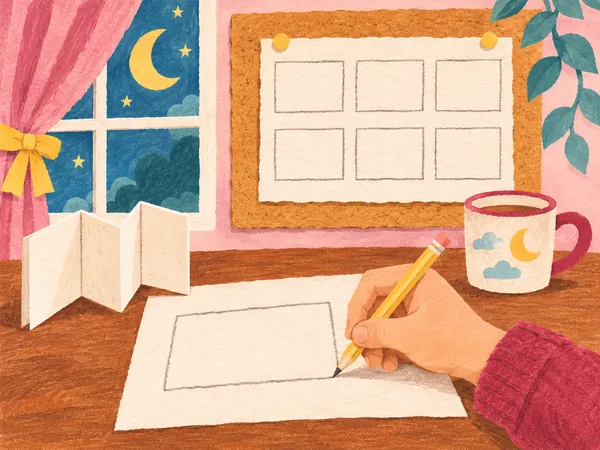
To see your story in that shape, make a dummy. Fold eight sheets of paper in half, staple them into a 32-page booklet, and write your text onto the pages in rough pencil. You will quickly see where a spread is crowded, where one is empty and where the story sags in the middle.
Keep the word count low
Penguin gives a range of 500 to 1,000 words for story picture books, but many agents and editors, particularly in the US, now prefer fiction texts under about 500. Shorter is not a target for its own sake. The pictures carry the setting, the clothes, the weather and a lot of the jokes, so any sentence that describes what the illustration will obviously show can usually go. Where the Wild Things Are runs to 338 words.
You do not need to find an illustrator. Penguin's guide is clear that publishers pair texts with illustrators themselves. Add an illustration note only when the picture must show something the words deliberately leave out.
Make every page turn count
The page turn is the picture book writer's best tool, because it is a built-in pause and a reveal. End a spread on a question, a setback or the moment before a surprise, and put the answer on the next one. Comedy works the same way: set the joke up on the left and let the turn deliver it. In your dummy, mark each page turn and ask what makes a child want to turn it.
Write for the ear
Read every draft aloud, then ask someone else to read it to you. You will hear the clumsy sentences you cannot see. Strong verbs, short lines and a refrain children can join in with all help. If you write in rhyme, the rhythm has to be perfect on every line; rhyme that forces odd word order or trips the reader is worse than plain prose. Many of the best picture books do not rhyme at all.
Revise, then proofread
Revise in passes. Check the story first, then the pacing across your dummy, then the language line by line. Put the manuscript away for a week between passes if you can.
Then proofread. In a manuscript this short, one typo is easy to spot and hard to forgive. Read it aloud one last time, then check spelling and punctuation with fresh eyes or a tool. Wordfully is an online proofreading tool that checks grammar, spelling and punctuation as you type, and its browser extension works in Chrome, Edge, Brave and Opera, so it can also look over the query letter you write in your email. Treat every suggestion as a suggestion, though: picture book text often bends grammar on purpose, and a fragment in a refrain may be exactly right.
Five mentor texts to study
Ages 2–5Written byPat Hutchins
PublishedMacmillan · 1968
Rosie's Walk
The whole text is a single sentence about a hen going for a walk around the farmyard. It never mentions the fox who is following her, and the fox is where all the comedy lives: every page turn shows another of his plans going wrong behind Rosie's back. Study it as the purest example of words and pictures telling two different stories. If your manuscript describes what the pictures will obviously show, Rosie's Walk is the cure. Read it to a child and watch them warn the hen about a danger the words never name.
Ages 4–8Written byMaurice Sendak
PublishedHarper & Row · 1963
Where the Wild Things Are
Max is sent to bed without his supper, his room turns into a forest, and he sails away to where the wild things are. In just 338 words the story moves all the way from fury to comfort. Notice how the pictures grow larger as Max's adventure grows wilder, until the wild rumpus fills whole spreads with no words at all, and then shrink again on the way home. Study it for pacing, and for proof that a very short text can carry a very big feeling.
Ages 4–8Written byJon Klassen
PublishedCandlewick Press · 2011
I Want My Hat Back
A bear has lost his hat and asks every animal he meets whether they have seen it. The text is entirely dialogue, with no narration, and it runs on repetition: the same question, slightly different answers. The rabbit's overlong denial is the clue, and the ending leaves the worst part to the reader's imagination. Study it for restraint. Klassen trusts his readers to work things out, and even four-year-olds rise to it. It also shows how much humour a writer can get from what a character does not say.
Ages 3–6Written byMo Willems
PublishedHyperion Books for Children · 2003
Don't Let the Pigeon Drive the Bus!
The bus driver has to step away and asks the reader one favour: do not let the pigeon drive the bus. Then the pigeon starts pleading, bargaining and finally melting down, and every child listening gets to say no. Study it for direct address, for a voice that sounds exactly like a preschooler negotiating bedtime, and for how simple drawings on a plain background keep the focus on character. It also shows how much children enjoy being given a job to do inside the story.
Ages 2–5Written byLynley Dodd
PublishedMallinson Rendel · 1983
Hairy Maclary from Donaldson's Dairy
Hairy Maclary sets off for a walk around town and is joined, one by one, by his friends Hercules Morse, Bottomley Potts, Muffin McLay, Bitzer Maloney and Schnitzel von Krumm. Then they meet Scarface Claw. Lynley Dodd's verse scans perfectly, the names are a pleasure to say, and each new dog adds a line to a growing cumulative pattern. Study it if you want to write in rhyme. It shows that rhyme only works when the rhythm never stumbles, and that invented names can carry the music.